
For four years, conservatives have insisted that overturning Roe v. Wade simply “returned the issue to the people.” This November, the people get to answer again.
Since the Dobbs decision in 2022, voters in states as different as Kansas, Michigan, Ohio, and Missouri have sided with reproductive freedom when the question was put to them directly. Rather than accept those results, some Republican legislators are now asking voters to reverse them, often by pairing abortion bans with measures aimed at transgender young people.
That pairing isn’t an accident. Progressive strategists at the Ballot Initiative Strategy Center note that it echoes 2004, when same-sex marriage bans landed on the ballot in 13 states to drive conservative turnout in a presidential year.
Ballot measures strip away party labels, attack ads, and candidate personalities. What’s left is a simple question: should politicians make this decision, or should you?
This year, voters face that question on three fronts: abortion, marriage and equal protection, and the rights of transgender kids.
Abortion: Defend, Restore, or Repeal
Four states will vote on abortion this fall, and abortion-rights supporters are not only playing defense.
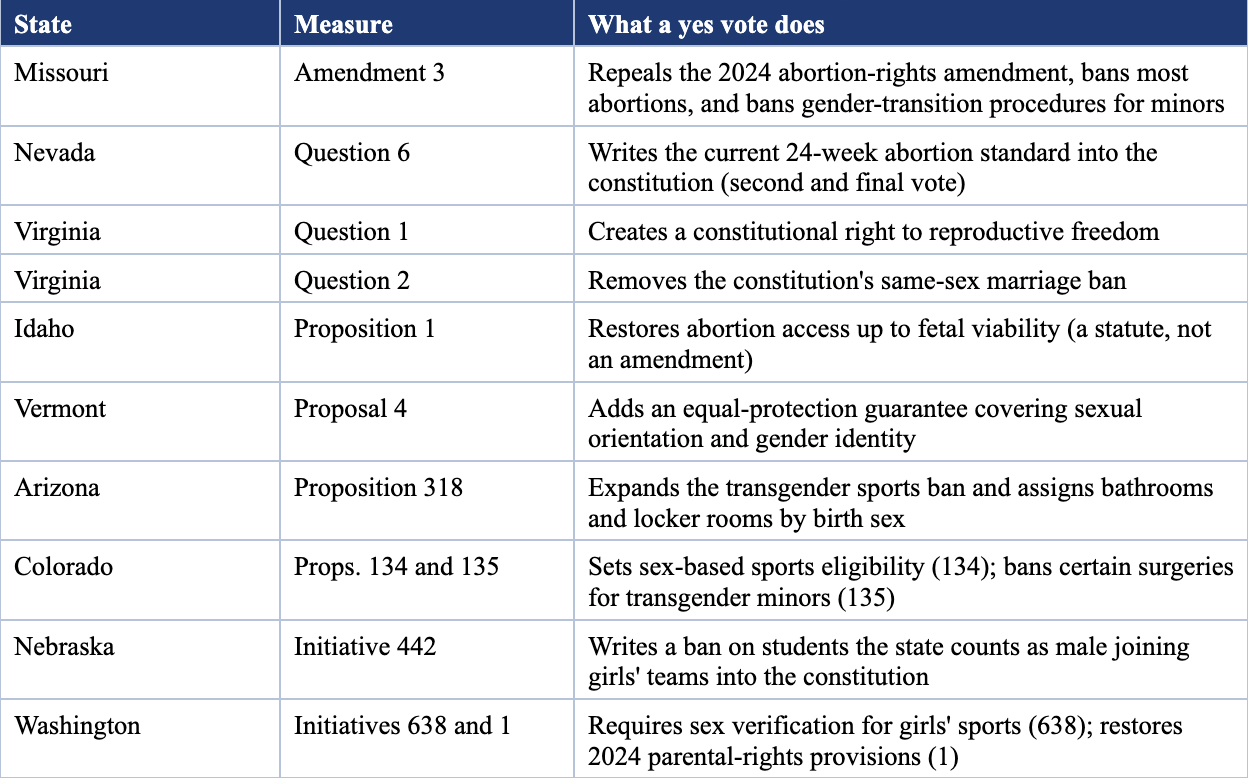
In Missouri, lawmakers are asking voters to overturn themselves. In 2024, Missourians approved a constitutional amendment protecting abortion rights with roughly 1.5 million votes. The Republican-led legislature responded by sending voters Amendment 3, which would repeal those protections and ban nearly all abortions. Abortion would be allowed only in a medical emergency, for a fetal anomaly, or, during the first 12 weeks, for a pregnancy resulting from rape or incest. Lawmakers also folded in a constitutional ban on gender-transition procedures for minors, and the yes campaign’s first TV ad was about “trans extremists,” not abortion. Even some anti-abortion activists have called that messaging misleading. An August SLU/YouGov poll found the race essentially tied, with 43% in favor and 44% opposed.
In Nevada, supporters are trying to lock in a landslide. Nevadans approved Question 6 with 64.4% of the vote in 2024, but state law requires citizen-initiated amendments to pass twice. A second yes vote would move Nevada’s current 24-week abortion standard from statute into the constitution, where a future legislature or governor couldn’t quietly roll it back. Nevadans for Reproductive Freedom has raised more than $815,000 this year; opponents have raised far less.
In Virginia, reproductive freedom would become a constitutional right. The Democratic-led General Assembly passed two amendments on reproductive freedom and marriage in both 2025 and 2026, as the state requires. Question 1 would establish a constitutional right to reproductive freedom, covering contraception, abortion, miscarriage management, fertility care, and pregnancy care, while allowing third-trimester restrictions with medical exceptions. (See below for Question 2).
In Idaho, voters could restore care in a ban state. Idaho’s near-total abortion ban has no exception to protect a patient’s health, and a federal judge ruled in August that the omission is unconstitutional. The ban has also driven doctors away: one study found a net loss of 94 OB-GYNs within two years. Proposition 1, the Reproductive Freedom and Privacy Act, would make abortion legal again up to fetal viability and safeguard birth control and fertility care. A Boise State poll found 61% support, including about 45% of Republicans. Because Idaho doesn’t allow citizen-initiated constitutional amendments, Prop 1 is a statute that the Legislature could later amend or repeal.
The clearest test is whether reproductive freedom still crosses party lines. If Idaho passes Prop 1 and Missouri rejects Amendment 3, it will be hard for anyone to argue that abortion rights are a coastal, partisan cause. The second test is whether pairing an abortion ban with a ban on care for transgender kids actually works. Missouri’s yes campaign is betting it does. A loss there would suggest voters can see past a strategy built to change the subject.
Marriage and Equal Protection
Virginia would finish the job on marriage equality. Its Question 2 would remove the 2006 amendment defining marriage as one man and one woman. That language has been unenforceable since Obergefell in 2015, but it is still in the constitution. UVA’s Larry Sabato calls the repeal an “insurance policy” in case federal protections change.
Vermont would guarantee equal protection for everyone. Proposal 4 would write an explicit equal-protection guarantee into Vermont’s constitution. The state could not treat people unequally because of their race, religion, or sex, and the amendment names sexual orientation, gender identity, and gender expression as protected traits too. It cleared the legislature in two consecutive sessions before going to voters.
Together, Virginia and Vermont offer a chance to write equality into state constitutions rather than carve exceptions out of it.
Transgender Kids in the Crosshairs
The rest of this year’s measures run the other way, aiming at transgender young people in schools, on sports teams, and in doctors’ offices. These sports and facilities measures will be harder fights, and progressives should be honest about that.
Arizona would police bathrooms and ballfields. Proposition 318, which the Republican legislature placed on the ballot, would widen Arizona’s ban on transgender athletes so it reaches additional schools and sports groups. It goes beyond sports: bathrooms, changing areas, and similar spaces would be assigned by the sex on a person’s birth record, and anyone who believes the rule was broken could sue.
Colorado is asking two questions in two votes. Proposition 134 would decide by sex who can play on school and college teams. Proposition 135 would outlaw certain surgeries for transgender minors, though it carves out some medical cases. Splitting the questions will show whether voters in a state that has leaned blue for two decades treat them differently.
Nebraska would write exclusion into its constitution. Initiative 442 would write a sports rule into the Nebraska Constitution itself. Every covered team would be labeled boys’, girls’, or coed, and students the state counts as male could not join girls’ teams. The rule would apply from kindergarten through college, intramurals included.
Washington is pairing sex checks with classroom fights. Initiative 638 would bar transgender girls from girls’ K-12 competitions and require a health care provider to verify the biological sex of students in those competitions. That means every girl who plays, not only transgender athletes, could face that verification. A companion measure, Initiative 1, would bring back provisions on school records, curriculum review, and parent notifications from the state’s 2024 parental-rights law, which lawmakers later revised.
Who Decides
On November 3, the question in most of these states comes down to the same thing: who decides. For a growing number of voters, the answer has been not the politicians.
State Ballot Initiative Summary