


Big Picture
If you wanted to pick the hardest place in America to get people off fossil-fuel heat, you might pick Maine. It has long winters, some of the oldest housing in the country, and more households heating with oil than any other state.
Maine is also where heat pumps went mainstream.
In 2019, Governor Janet Mills signed a law setting a goal of 100,000 new heat pumps by 2025. The state hit it in July 2023, two years early, and Mills promptly set a bigger target: 175,000 more by 2027. Along the way, the share of Maine households that heat primarily with oil fell from 62% in 2018 to 50% in 2024, according to federal survey data cited by the state.
Maine has answered the question most skeptics asked first: whether heat pumps work in a cold, poor, rural state. The next question is a harder one: Did Maine sell a lot of heat pumps, or did it get a lot of homes off oil? Those turn out to be different achievements.
Maine’s Heat Problem Was a Pocketbook Problem
Maine’s climate policy makes more sense once you see that it started as a fight over heating bills.
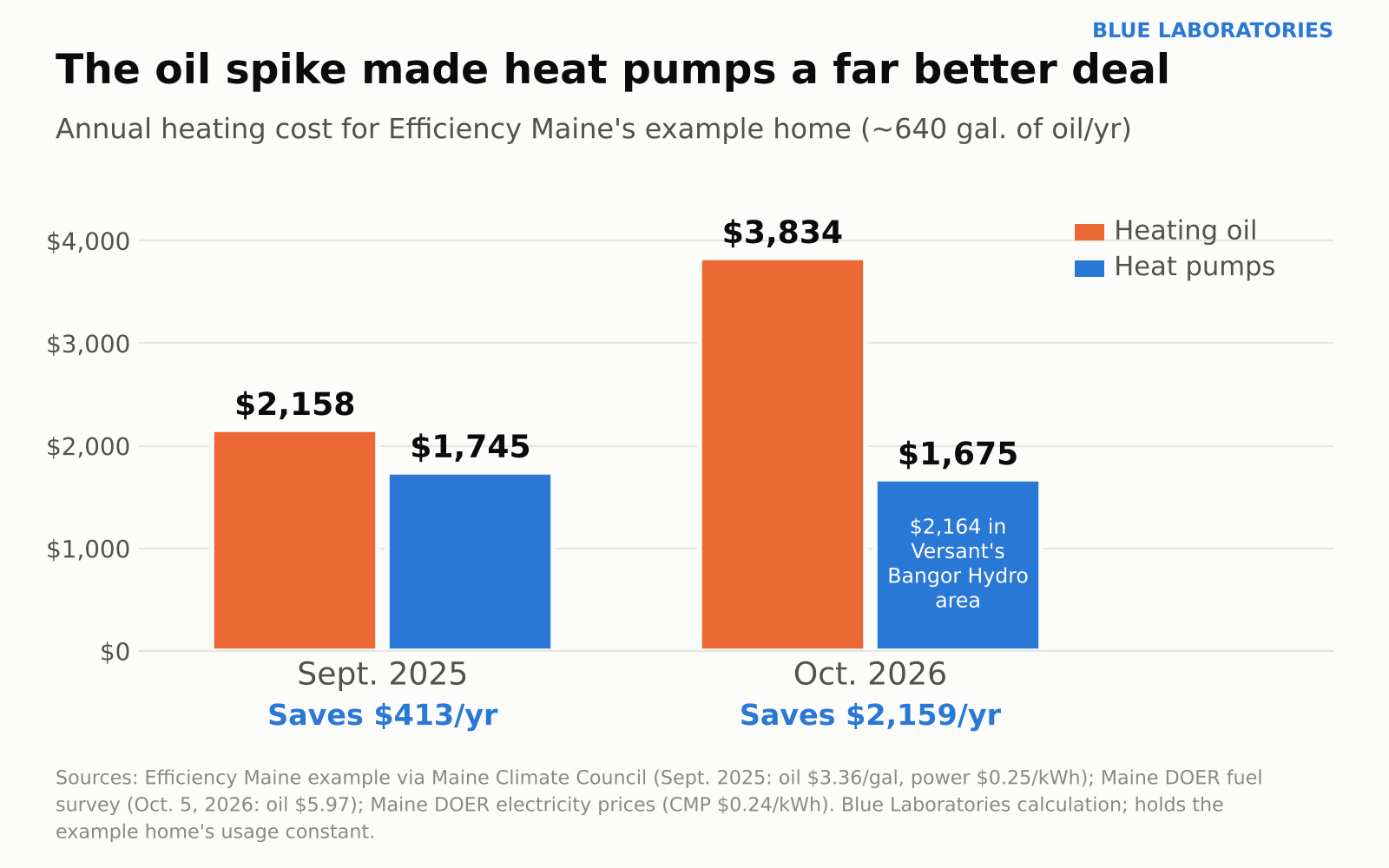
According to state data, Maine spends more than $4.5 billion a year on imported petroleum. Nearly all of it leaves the state, and Mainers have no say over what it costs. In September 2025, heating oil cost about $3.36 a gallon. By the end of March it was $5.37, and this month it reached $5.97 amid the war with Iran. For a home burning about 640 gallons a year, that swing adds roughly $1,700 to the annual heating bill.
Unsurprisingly, the burden falls hardest on low-income households. A 2024 study commissioned by the state’s Office of the Public Advocate found that low-income Mainers spend roughly 14% of their income on home energy, compared with about 5% for all households. Counting gasoline, low-income households spend about 30% of their income on energy. And those that heat with oil spend roughly twice as much of their budget on energy as those that heat with electricity.
Heat pumps offered a way out. They swap an imported fuel whose price Maine can’t control for electricity that is increasingly renewable: 55% of the electricity Maine used in 2024 came from renewable sources.
That is the context for everything that followed. Maine’s heat pump push was designed, and sold, as a cost-of-living policy. Emissions cuts came along with it.
What Did Maine Actually Build?
Maine’s heat pump program came in four layers.
The Goal - In 2019, the Maine Legislature passed LD 1766 with bipartisan support and it was signed into law by Governor Mills. LD 1766 set the goal of 100,000 heat pump installations (requiring at least 15,000 heat pumps in income-eligible homes), expanded rebates, and created a low-income heat pump program at the state housing authority, MaineHousing. The same session created the Maine Climate Council, whose plan, Maine Won’t Wait, set longer-range goals for 2030.
The Administrator - The rebates run through Efficiency Maine Trust, a quasi-state agency created by the Legislature. It is not a utility program and not a regular state department. It operates on three-year plans approved by the Public Utilities Commission, which gives contractors and homeowners an unusual degree of predictability. Its money comes from a mix of utility efficiency charges, proceeds from the regional carbon market (RGGI), electricity capacity-market revenue, and federal grants. Notably, it uses no general-fund tax dollars.
The Rebate Design - Rebates are tiered by income: up to $3,000 for any homeowner and up to $9,000 for low-income households. But the most important rebate design choice came later. After initial implementation, Efficiency Maine’s own research found that many homeowners were installing one or two heat pumps and using them as supplements while the oil boiler kept heating the house. That undercut both savings and emissions cuts. So in 2023 the agency changed course and began paying rebates only for systems sized to heat the entire home.
The Ratepayer Payoff - The Beneficial Electrification Policy Act, enacted into law by Maine in 2023, lets Efficiency Maine spend ratepayer money on electrification when it lowers costs for the whole system. The logic: when more electricity is sold, especially off-peak, the fixed cost of poles and wires is spread across more kilowatt-hours, and rates fall for everyone. Efficiency Maine projects its current three-year plan will hold rates about $492 million below where they would otherwise be. This idea may be the most exportable thing Maine has done. It turns electrification from a cost that non-participants subsidize into a benefit that, at least on paper, they share.
So, Is It Working?
By the Mills administration’s accounting, yes.
According to the Climate Council’s December 2025 report, Efficiency Maine and MaineHousing programs had installed 181,024 heat pumps since 2019, as of August 2025. The record year was fiscal 2025, with nearly 37,000 installs. In March 2026, Mills said the total had passed 200,000. As of August 2025, nearly 22,000 had gone into low and moderate-income homes, beating the law’s equity goal.
The strongest evidence isn’t the install count, though. It’s the oil data. A 12-point drop in the share of oil-heated homes in six years is a household-level outcome measured by federal surveys, not a program tally. That drop is hard to explain without real displacement of oil.
Key Policy Takeaway: The Institution Did the Work
The 100,000 goal got the headlines. But a goal doesn’t install anything.
What has made Maine’s policy work is the institution behind the goal: an administrator with stable, multi-year funding that doesn’t depend on an annual appropriations fight, a rebate structure that contractors could build a business around, and a willingness to change the program when its own data said it wasn’t delivering.
That contractor base didn’t appear on its own. The state built a workforce pipeline alongside the rebates, with heat pump training labs at community colleges, and nearly 700 installers are now registered with Efficiency Maine. Rebates create demand; trained installers are what turn it into installs.
The last point also deserves emphasis. Plenty of programs measure success by how much money goes out the door. Efficiency Maine looked at how heat pumps were actually being used, concluded that part of its program was underperforming, and redesigned it, accepting lower unit counts in exchange for deeper conversions.
A contrast with Massachusetts’ heat pump program is instructive and shows why the structure matters. Massachusetts also beat its 2025 heat pump goal early, but its program, Mass Save, is run by the state’s utilities. When regulators cut $500 million from its proposed budget in 2025, the utilities’ revised plan aimed its largest proposed cuts at heat pump incentives ($220 million). Installations there fell that year, while Efficiency Maine posted its best year on record.
The Turn: Units Aren’t Homes
Here is the complication. The goals Maine have celebrated thus far only count heat pump units. The goals that matter for oil use and emissions must count homes.
A typical Maine home needs about three units to heat it fully. So 200,000 heat pumps represent far fewer whole-home conversions. The climate plan’s targets include 130,000 homes partly heated by heat pumps and 115,000 homes fully heated by them, both by 2030.
The state’s own December 2025 report is candid about where those stand. The partial-home goal will likely be met by 2027, largely through installs that happen without incentives. The whole-home goal will require a significant ramp-up by 2030, and more funding than the current three-year plan provides. Even the unit goal is now a stretch. Reaching 275,000 by the end of 2027 from the August 2025 count requires roughly 40,000 installs a year. That’s more than Maine has ever done in a year, and it would have to happen after the federal tax credits disappeared.
The deeper vulnerability is price. Heat pumps save money because electricity is cheaper than oil for the same heat. When Efficiency Maine ran the numbers in September 2025, with oil at $3.36 a gallon, a home converted from oil saved about $413 a year. At this month’s prices ($5.97 a gallon for oil in the state’s Oct. 5 survey, and 24 to 31 cents per kilowatt-hour for electricity, depending on the utility), the same home would save roughly $1,700 to $2,200 a year, by Blue Laboratories’ calculation using Efficiency Maine’s example. Meanwhile, Maine’s electricity prices have risen at the third-fastest rate in the nation over the past decade.
This winter’s oil spike has multiplied that advantage four- to fivefold. But a policy whose value depends on world oil prices staying high is standing on a moving floor.
There’s an equity question, too. Whole-home systems cost more up front, and some have opposed the state’s shift to whole-home rebates on the grounds that affluent homeowners and developers would capture the benefits. Efficiency Maine counters that its income tiers were designed to prevent that. The results are mixed: low-income adoption has grown, to about 13% of low-income homeowners, but the 2030 goal of 40,000 heat pumps in low-income homes was still less than halfway met as of August 2025.
The Politics of Heat Pumps
If the policy lesson is about institutions, the political lesson is about framing.
Maine’s heat pump law passed with bipartisan support, and the ratepayer-funded efficiency model predates Mills. Her pitch has consistently led with savings, comfort and energy independence, and only then climate.
The result is a climate program with no organized partisan opposition. The fuel-dealer industry fought specific rules, like the disconnect requirement, but no major political force has campaigned against heat pumps themselves.
What happens next depends on the governor’s race. Democrat Hannah Pingree co-chaired the Climate Council as Mills’s policy director and has said she would continue the plan. Independent Rick Bennett also supports it. Republican Bobby Charles has made energy affordability his top issue and wants an all-of-the-above approach that includes new natural gas pipelines. Notably, he has blamed solar incentives, not heat pumps, for higher electricity costs.
The risk to the program isn’t a direct attack. It’s that the money funding it, carbon-market proceeds and charges on electric bills, becomes a target in a campaign about electricity rates. With the Legislature closely divided and every seat on the ballot, that’s a real possibility in 2027.
The Blueprint for Other States
Maine’s experience offers five lessons.
Build an institution, not just a goal. Targets generate press releases. A trusted administrator, a contractor network and a stable rebate structure generate installs.
Fund it off-budget and multi-year. Efficiency Maine’s ratepayer and carbon-market funding, approved in three-year plans, let contractors plan around it. Programs that live or die in annual budgets can’t offer that stability.
Count homes, not units. A unit target is easy to beat and easy to celebrate. The measure that tracks oil use and emissions is the number of homes that stop burning fossil fuels. Maine’s climate dashboard reports heat pump units and low-income installs, but not how many homes have fully converted. Publishing that number, and setting goals against it, is the clearest next step for Maine and the easiest for other states to copy.
Redesign when the data says to. Maine’s shift to whole-home rebates cost it easy numbers and bought it real conversions. That willingness to change course is rarer than it should be.
Sell it as a bill, and protect the bill. Maine won bipartisan support by framing heat pumps as savings. That only holds if electricity stays affordable, which means a heat pump strategy is also an electricity-rate strategy.
Bottom Line
Maine has done something most states only promise. It took the most oil-dependent housing stock in the country and made heat pumps an ordinary purchase, with bipartisan support and without general-fund dollars.
Mills and Efficiency Maine deserve credit for treating delivery as the hard part. But the easy half is done.
The goal Maine beat counted machines; the goal that matters counts homes.
Maine proved heat pumps work in the cold. It’s up to the next governor and legislature to prove a state can move most of its homes off oil.