
The Big Picture
Politicians in both parties love to talk about “working families.” This November, voters in a handful of states get to decide what that phrase is actually worth.
In several states, the question is whether the wealthiest residents should pay more. In others, the wealthy have answered with competing measures written to make sure they don’t.
The stakes are higher than usual. Federal Medicaid cuts have left states scrambling to fill holes in health care and food assistance budgets, and the money has to come from somewhere.
Polling shows that most Americans think the rich don’t pay their fair share. These measures test whether that sentiment survives contact with a well-funded opposition campaign.
Taxing the Top
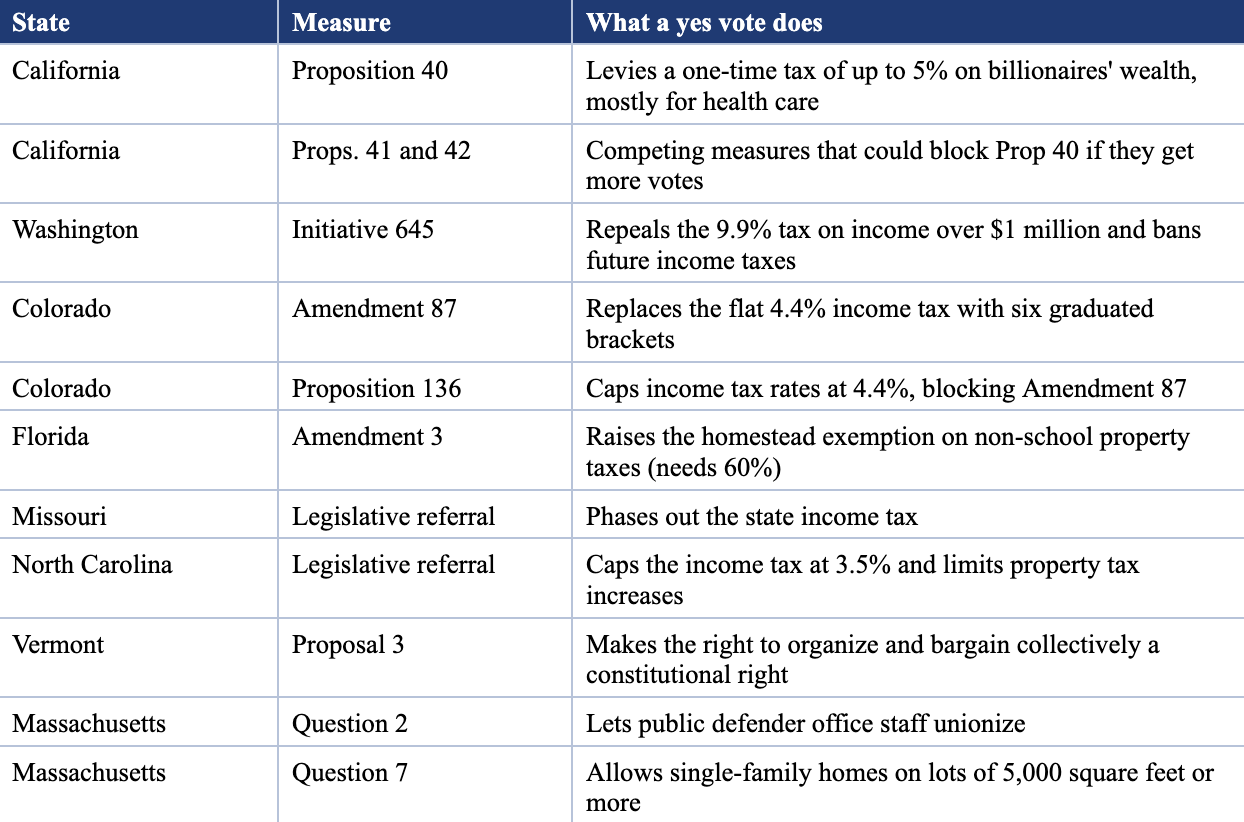
In California, it’s billionaires vs. everyone else. Proposition 40, sponsored by SEIU United Healthcare Workers West, would ask California’s billionaires to pay a one-time levy of as much as 5% of their wealth, with most real estate and retirement savings left out of the calculation. The nonpartisan Legislative Analyst’s Office estimates it would raise “tens of billions of dollars,” with 90% going to health care and the rest to education and food assistance. Supporters pitch it as a way to fill holes left by federal Medicaid cuts. Billionaires answered with two competing measures, Propositions 41 and 42, funded in large part by Google co-founder Sergey Brin. Either could block Prop 40 if it passes with more votes. A September PPIC poll found 52% support for Prop 40, but majorities also backed both countermeasures, which means confused voters could cancel out their own choice. Notably, Governor Gavin Newsom, a Democrat with potential presidential aspirations, opposes Prop 40.
In Washington, voters will decide whether to keep the millionaires’ tax. Earlier this year, the Washington legislature passed a 9.9% tax on household income above $1 million, which officials estimate about 25,000 households would pay. It is expected to raise more than $3 billion a year starting in 2028, while funding tax cuts for small businesses, expanded rebates for low- and middle-income residents, and an end to sales tax on diapers and hygiene products. Initiative 645 would repeal the tax and ban any future state or local income tax, permanently locking in one of the most regressive tax systems in the country. Notably, I-645 would keep the tax breaks for everyone else while eliminating the revenue that pays for them.
In Colorado, the choice is a fairer income tax or a permanent cap. Amendment 87 would replace Colorado’s flat 4.4% income tax with six graduated brackets starting in 2027. Most taxpayers would get a cut, higher earners would pay more, and the state would raise up to $2.7 billion in its first full year for schools, health care, and child care. Proposition 136 would cap income tax rates at 4.4%, blocking Amendment 87. Democratic Governor Jared Polis opposes 87 and supports 136, along with Proposition NN, which would let the state keep up to $4.6 billion more under its TABOR revenue limit.
The opposition has learned a new trick. In California and Colorado, a tax on the top doesn’t just face a “no” campaign. It faces a competing measure on the same ballot that would cancel it. If voters back both sides, as California’s polling suggests some will, the side with the better-funded campaign may win without changing a single mind.
The results won’t fall neatly along party lines, either. Democratic governors in California and Colorado oppose the progressive tax measures in their own states, arguing they would hurt their states’ economies or drive away wealthy residents. Their voters will decide whether that warning outweighs the cost of cuts to health care and schools.
Tax Cuts With a Catch
Florida’s tax cut could be paid for by cops and firefighters. Amendment 3 would shield more of a primary home’s value from local, non-school property taxes, lifting the exemption to $150,000 in 2027 and $250,000 in 2028, and cut the assessment cap on rentals and second homes from 10% to 5%. That sounds like relief, but local governments would lose substantial revenue, and the Florida Sheriffs Association and firefighter groups warn it could cut public safety budgets. Newer Floridians would wait years for the full benefit. It needs 60% to pass, and recent polls range from 42% to 63% support, so it’s unclear whether it will clear that bar.
Missouri and North Carolina would shift the burden down. Missouri’s legislature has asked voters to phase out the state income tax while changing sales taxes, and North Carolina’s would cap its income tax at 3.5% and limit property tax increases. Replacing income taxes with sales taxes generally shifts the load toward lower- and middle-income families, who spend a larger share of what they earn.
Workers and Homes
Vermont and Massachusetts would expand the right to organize. Vermont’s Proposal 3 would make workers’ right to organize and bargain collectively a constitutional right, joining a short list of states that guarantee it. In Massachusetts, Question 2 would let public defenders and other staff at the Committee for Public Counsel Services unionize and bargain collectively.
Massachusetts would make room for starter homes. Question 7 would allow single-family homes on lots of 5,000 square feet or more, overriding local zoning, a direct shot at the large-lot rules that keep housing scarce and expensive. The state’s municipal association opposes it as a one-size-fits-all mandate.
Bottom Line
These contests will offer one of the clearest answers available to a question both parties claim to care about: when the bill comes due, who should pay it?
State Ballot Initiative Summary