
The Big Picture
Most elections decide who holds power. This year, a record number of ballot measures will decide how power is won.
Of the 145 statewide measures on ballots this fall, 39 deal with elections, a record, according to National Conference of State Legislatures figures reported by Votebeat. Six states will vote on new voter ID requirements, also a record. Six more will vote to declare that only citizens may vote, something that is already the law everywhere in the country for state and federal elections.
Some of these measures would expand access. Many more would add hurdles, lock in partisan maps, or make it harder for citizens to put questions on the ballot at all.
The common thread is a fight over who gets to participate, and who gets to set the rules for everyone else. On this year’s ballots, that fight comes down to four questions.
Who Draws the Lines?
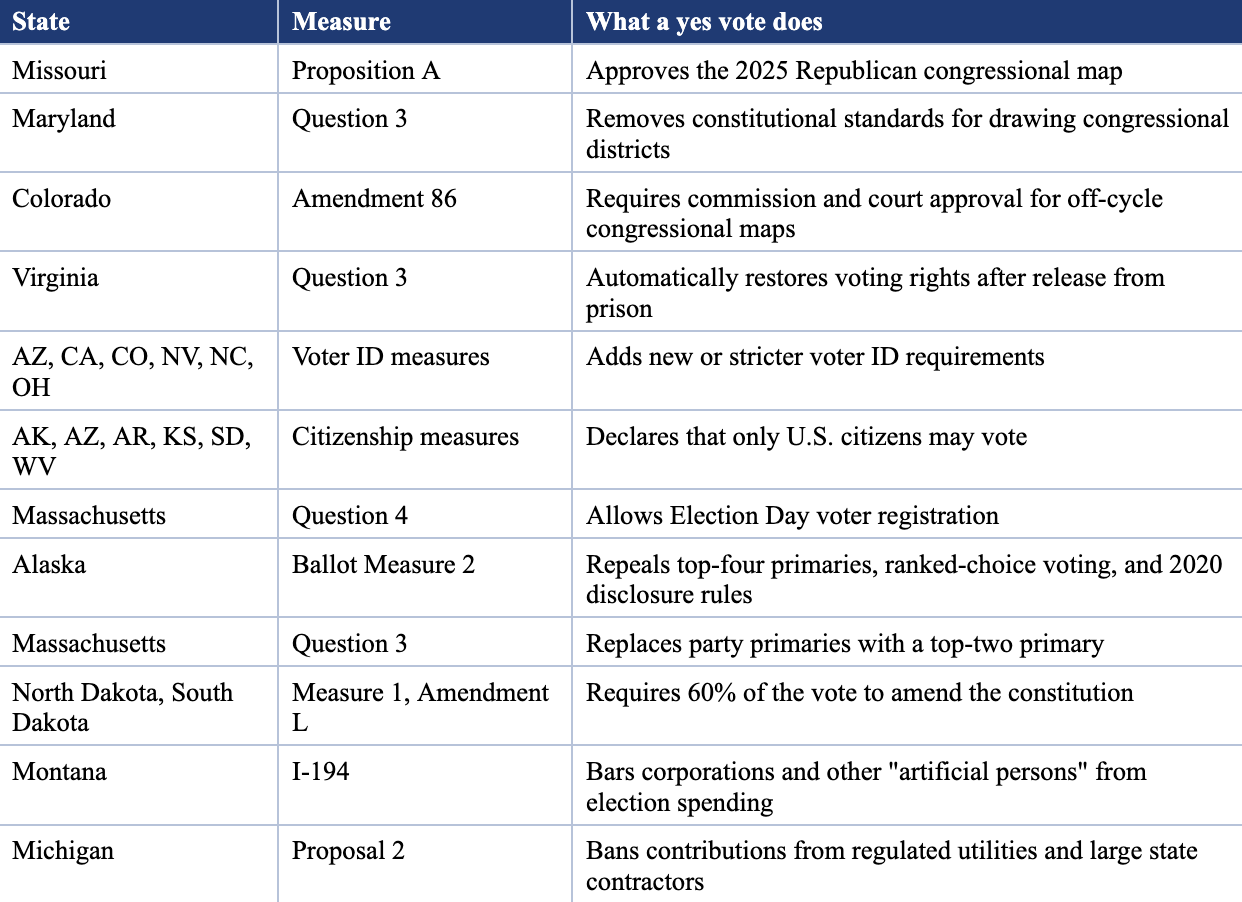
Missouri voters get the last word on a gerrymander. Last fall, at President Trump’s urging, Missouri Republicans redrew the state’s congressional map mid-decade. The new lines stretch Rep. Emanuel Cleaver’s Kansas City district nearly 200 miles east, pairing majority-Black urban neighborhoods with rural counties to create a safe Republican seat. Citizens with People Not Politicians gathered more than 300,000 signatures to force a referendum. The secretary of state tried to keep it off the ballot, but the Missouri Supreme Court unanimously ruled that voters will decide. Under Proposition A, a yes vote approves the 2025 map and a no vote keeps the 2022 lines, which are being used this November. Polling shows voters evenly split.
Maryland Democrats want to fight fire with fire. Question 3 would remove the state constitution’s standards for drawing congressional districts, clearing the way for Democrats to redraw a map that already gives them seven of eight seats. Supporters, including Democratic lawmakers and labor unions, frame it as a direct response to Trump’s mid-decade redistricting push in red states. Republicans call it a confusing ploy to energize the Democratic base, and even some sympathetic voters may balk at answering one gerrymander with another. The Maryland Supreme Court rewrote the ballot question after finding the original wording misleading, and dueling polls show anywhere from 25% to 31% of voters undecided. Changes couldn’t affect races until 2028.
Colorado conservatives want to tie Democrats’ hands. Amendment 86, backed by the conservative group Advance Colorado, would require any off-cycle congressional map to win approval from the state’s independent commission and its supreme court. It follows a Democratic push to redraw the map before 2028. Supporters call it gerrymandering protection. Opponents argue it would leave Colorado unable to respond while Republican states redraw their own maps at will.
These may be the most revealing votes of the year. Missouri voters will be the first to directly judge a Trump-era mid-decade gerrymander. Maryland voters will decide whether Democrats should answer in kind. How each state votes will show whether voters punish map-rigging in general or only when the other side does it.
Who Gets to Vote?
Virginia would restore the right to vote. Virginia is one of the few states where a felony conviction can mean losing the right to vote for life unless the governor intervenes. Question 3 would establish a fundamental right to vote and automatically restore voting rights to people when they’re released from prison. It would also replace the constitution’s “mentally incompetent” language with a narrower standard.
Six states are riding a record wave of voter ID. Voters in Arizona, California, Colorado, Nevada, North Carolina, and Ohio will decide voter ID measures. The biggest fights are over mail ballots. California’s Proposition 39, from Republican Assemblymember Carl DeMaio’s Reform California, would require ID at the polls and ID numbers on mail ballots; Common Cause warns it sets no rules for fixing ballot errors. A UC Berkeley poll found 56% initial support, falling to 39% once voters learned who was behind it. Arizona’s legislature-referred Proposition 144 would require proof of identity from every voter, including mail voters, and critics say it could burden older, disabled, and rural voters. In Nevada, Question 7 returns for its required second vote after winning 73.2% in 2024.
Six more are solving a problem that doesn’t exist. Alaska, Arizona, Arkansas, Kansas, South Dakota, and West Virginia will vote on measures declaring that only U.S. citizens may vote. Noncitizens are already barred from voting in state and federal elections. One review in Arkansas found noncitizens made up about 0.00002% of registered voters. These measures have passed every time since 2018, so the real question is what they signal and what comes next, such as proof-of-citizenship rules that could trip up millions of eligible Americans who don’t have papers on hand.
Massachusetts would let voters register on Election Day. Question 4 would let eligible voters register or update their address at the polls on Election Day, with proof of residency, a reform already used in 24 states and D.C. The state Republican Party opposes it.
Voter ID and citizenship measures poll well, and they have a long winning streak: voters approved 10 of 13 voter ID measures between 2004 and 2025. Progressives shouldn’t expect to win most of those fights this year. The more useful signal is the margin, and whether California’s Prop 39 sinks once voters learn who wrote it, as the Berkeley poll suggests it might.
How Do We Pick Winners?
Alaska is voting on ranked-choice voting, again. Alaskans adopted open top-four primaries, ranked-choice general elections, and stronger dark-money disclosure in 2020. A repeal failed in 2024 by just 737 votes. Ballot Measure 2 would restore closed partisan primaries and, less noticed, repeal the 2020 disclosure rules for out-of-state and “true source” donations. The repeal campaign’s biggest funder is the Aurora Action Network, a Wisconsin super PAC partly funded by Pennsylvania billionaire Jeff Yass, which has supplied $846,000 of its $1.1 million.
Massachusetts would open up its primaries. Question 3 would replace party primaries with a single all-candidate primary, with the top two advancing, a change that third-party advocates warn would shut them out of November.
Who Gets to Write the Rules?
Then there are the quieter measures that change who gets to make the rules at all. They won’t dominate cable news, but they could shape what reaches the ballot for decades.
North Dakota and South Dakota would raise the bar for the people. Constitutional Measure 1 and Amendment L would require 60% of the vote, not a simple majority, to amend either state’s constitution. These follow years of voters using initiatives to pass policies legislators wouldn’t, from Medicaid expansion in South Dakota to term limits in North Dakota. A 60% rule would let a minority of just over 40% block what most voters want.
Montana and Michigan want corporate money out of politics. Montana’s I-194, the “Montana Plan,” takes a novel route around Citizens United: rather than challenge corporate speech rights, it redefines the powers the state grants corporations so they no longer include election spending. Former Republican Governor Marc Racicot supports it; the Montana Chamber of Commerce went to court to block it from the ballot and lost. Michigan’s Proposal 2 would bar regulated utilities like DTE and Consumers Energy, and companies with $250,000 or more in state contracts, from giving to candidates who oversee them, and require donor disclosure for issue ads close to elections.
Bottom Line
Taken together, the results will say a lot about whether Americans want a democracy that makes room for more voters, or one that makes it easier for those in power to stay there.
State Ballot Initiative Summary