


Big Picture
When Vermont lawmakers enacted Act 76 in 2023, they did more than enlarge a subsidy program. They made a bet about what child-care policy should become.
Instead of treating assistance as a narrowly targeted benefit for poor families, Vermont extended help deep into the middle class. Instead of asking providers to absorb the difference between what parents could pay and what care cost to deliver, the state increased reimbursement rates. And instead of financing the expansion through temporary federal aid or an annual budget scramble, lawmakers imposed a dedicated 0.44% payroll contribution.
Three years later, the early result is neither the universal success story advocates sometimes describe nor the tax-heavy cautionary tale opponents predicted. Vermont has made child care substantially more affordable for thousands of families and has begun to stabilize a shrinking provider market. But it still cannot produce enough workers and slots—especially for infants, toddlers, and families in thin rural markets.
That mixed result is precisely what makes Vermont’s policy approach to child care particularly valuable for other states looking to address the child care crisis. Act 76 is a blueprint for how states can begin building a child-care system - it is also a warning that financing demand is faster than building supply.
Vermont’s Market was Broken
Child care has an unusual economic problem. It is too expensive for many families and still too cheap to support the wages necessary to retain workers. Providers cannot solve that contradiction by becoming more efficient: caring for infants and toddlers requires a high ratio of adults to children.
Vermont’s pre-reform data showed the damage. Between 2012 and 2023, the number of home-based providers fell nearly 60%. Statewide infant capacity declined 10% and toddler capacity 19%. By 2023, Vermont had fewer than 40 licensed slots for every 100 infants. Child-care workers earned roughly 55% of the average Vermont worker’s pay, and turnover exceeded the rate across the state economy.
The politics developed over more than a decade. Advocates framed child care as workforce infrastructure—something that allowed parents to work and employers to hire—while earlier legislation funded studies and incremental improvements. In 2023, the Democratic-led legislature passed H.217 over Republican Gov. Phil Scott’s veto. Scott agreed that child care needed investment but opposed the payroll tax and scale of spending.
That disagreement clarified the choice. A cheaper program could serve fewer families or pay providers less. Vermont chose a broad, durable system and attached a visible tax to it.
What Does Act 75 Do?
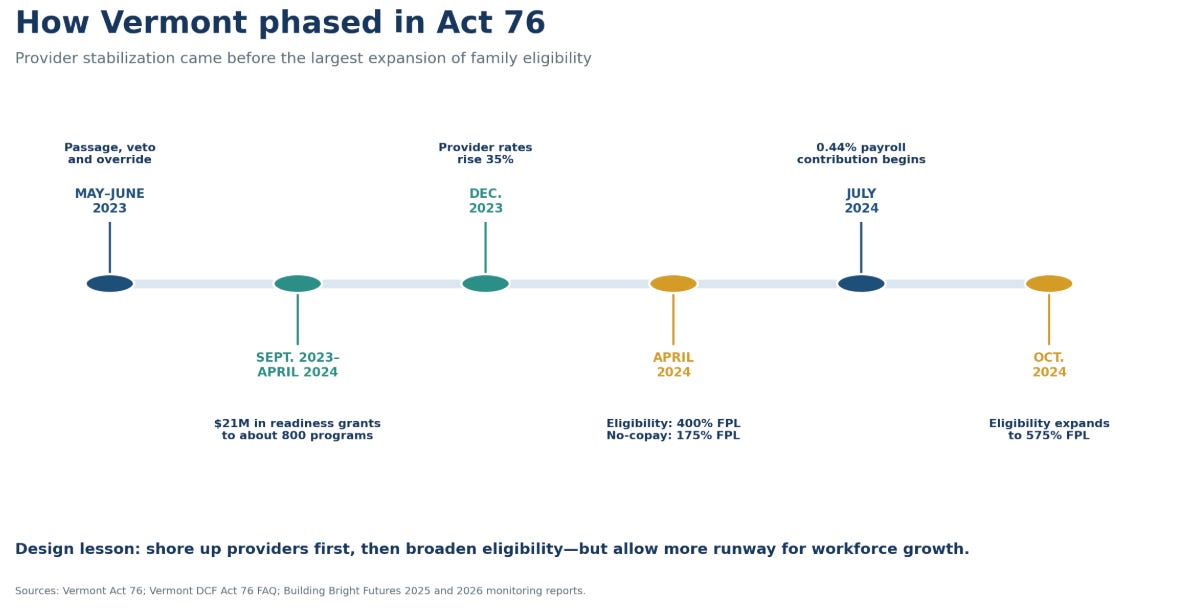
Act 76 expands eligibility for the Child Care Financial Assistance Program to 575% of the federal poverty level, bringing substantial portions of the middle class into the program. Families at or below 175% of poverty have no family payment; assistance then phases down as income rises.
On the supply side, Vermont raised provider reimbursements by 35%, stopped tying state payments to a provider’s lower private rate, and later narrowed the gap between payments to home-based and center-based programs. It also financed readiness, quality, and capacity grants.
The sequencing mattered. Stabilization grants and higher provider rates arrived before the final eligibility expansion in October 2024. In theory, that gave programs time to raise pay, hire, or reopen classrooms before subsidized demand peaked. The dedicated Child Care Contribution took effect in July 2024. The assessment equals 0.44% of covered payroll; employers can pass no more than one-quarter of it—0.11%—to employees. Through November 2025, it had collected about $99.6 million.
Ironically, the tax is both the policy’s political vulnerability and one of its chief strengths. Earmarked revenue is harder to quietly repurpose and gives providers more confidence that higher rates will last. But payroll taxes can modestly reduce compensation or hiring over time, even when employers formally pay them. States should acknowledge that cost rather than pretending the funding is free.
Key Policy Takeaway - Affordability Moved First
The clearest outcome is participation.
Child Trends found that families receiving subsidies increased 48%, from 5,389 in July 2023 to 7,983 in April 2025. State monitoring shows children enrolled in CCFAP rising from 7,533 in June 2023 to 12,234 in September 2025.
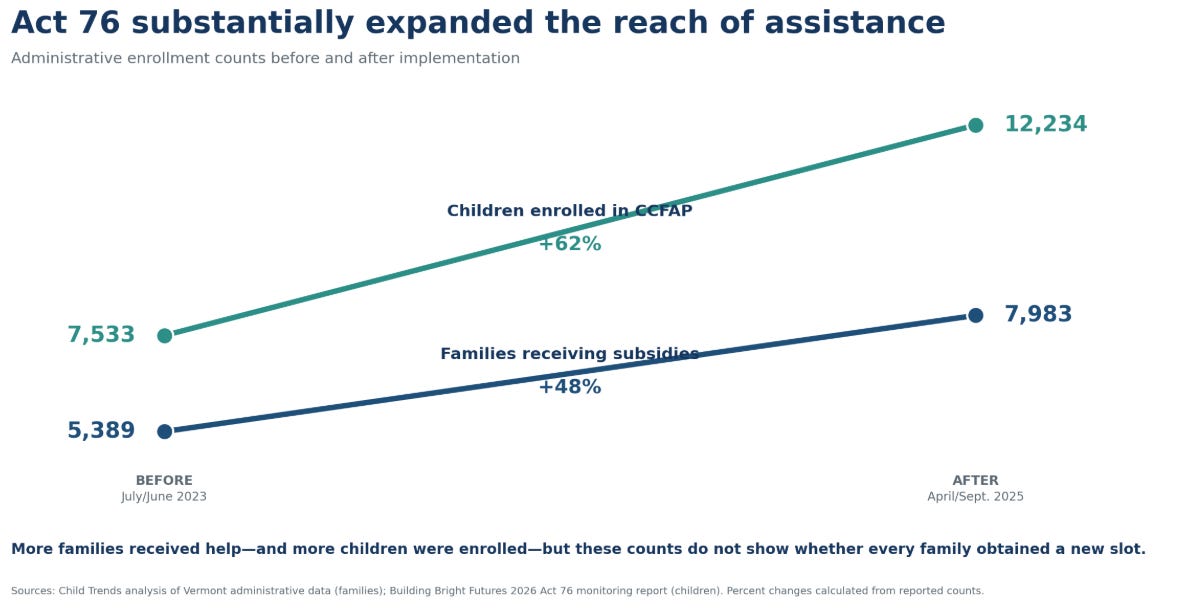
That does not prove every new enrollee obtained a new slot; some families were already paying privately and became eligible for help. But it does show that Vermont successfully reached beyond the traditional low-income subsidy population. For those families, the program converts a large, volatile household bill into a smaller payment tied to income.
The provider response is real but slower. Child Trends found a 2.4% increase in the number of providers between November 2023 and December 2024, including a 3% rise in home-based providers. The share of providers accepting subsidies increased by 4.8 percentage points. State data show licensed programs rising from 1,045 in September 2023 to 1,072 two years later.
Those are meaningful reversals after a long contraction, but they are not yet a supply transformation. Vermont’s 2026 monitoring report still identifies workforce shortages as the largest barrier to expansion. Affordability improved more rapidly than availability, and the gaps remain greatest where care is most labor-intensive.
The Strongest Critique is About Execution, Not Intent
Act 76’s early fiscal record also calls for humility.
State economists now expect the payroll contribution to raise about $11 million less per year than originally projected because the covered tax base was smaller than estimated. The program was not facing an immediate funding crisis: Vermont projected that roughly 99% of its approximately $172 million FY2026 CCFAP budget would be spent. Still, the miss is material and should shape other states’ planning.
Administrative complexity is another constraint. Providers have reported friction around enrollment-based payments and the interaction of child-care subsidies with Vermont’s prekindergarten system. Meanwhile, contemplated pre-K restructuring did not proceed on its original July 2026 timetable.
There is also an evidence problem. Vermont can document enrollment, payments, providers, and licensed capacity. It cannot yet confidently attribute changes in parental employment, statewide labor supply, child outcomes, or long-term provider wages to Act 76. Future evaluations should resist converting plausible benefits into measured ones.
The Blueprint for Other States
The lesson is not simply “adopt a payroll tax.” The model has five linked parts.
Finance families and providers together. Expanding subsidies without raising provider rates can create longer queues for the same scarce slots. Raising rates without family assistance leaves care unaffordable.
Stabilize supply before expanding eligibility. Vermont’s sequencing was sensible, even if the runway was too short to eliminate shortages.
Use permanent revenue—but forecast it conservatively. A replicating state should model collections at least 10% to 15% below the central estimate and create an automatic response if revenue or enrollment diverges from projections.
Pay explicitly for hard-to-provide care. Infant care, nonstandard hours, rural service, and care for children with specialized needs will not emerge evenly from a general rate increase. Enhanced rates and targeted capacity grants should be designed from the beginning.
Measure functional capacity, not just licenses. The relevant questions are whether classrooms are staffed, whether families can find hours that match work, and whether providers can retain employees with wages and benefits—not how many slots exist on paper.
Bottom Line
Vermont has not solved the child care crisis entirely but it has done something instructive: it has shown that a state can rapidly remove price barriers and interrupt provider decline, while revealing where cash alone stops working.
For Democrats looking for a governing model, Act 76 is worth adapting.
But the honest promise is not instant universality – it is a durable public system built in the right order—and judged by whether a parent can actually find care.