


Big Picture
Washington did not invent its rent cap. It borrowed one from a neighbor.
In 2025, Washington became the third state with a statewide rent cap, after Oregon and California. Its formula came almost word for word from Oregon: increases for sitting tenants are capped at 7% plus inflation, never more than 10%. For 2027, renters in both states face the same 10% limit.
That makes Oregon, which passed the nation’s first statewide cap in 2019, a six-year preview – and that record is more interesting than either side of the debate predicted.
Oregon and Washington’s caps are not rent control in the classic sense. In cities like San Francisco, rent control limits increases to a fraction of inflation and covers a unit no matter who lives in it. Oregon and Washington cap only increases for sitting tenants – landlords may reset to market rent when a unit turns over, and newer buildings are exempt entirely.
The cap, 7% plus inflation, sits well above what most landlords were charging anyway. Yet the first peer-reviewed study of Oregon’s law found that rents in covered buildings grew more slowly and tenants moved far less, even though the cap almost never forced a landlord’s hand. What Oregon can’t tell us is the cost: whether the cap discourages building or pushes rentals off the market.
Washington copied Oregon’s formula but changed the terms around it: a shorter exemption for new buildings, an attorney general who enforces the law, and an expiration date. Each change tests a question Oregon left open.
How Oregon & Washington Got Here
Oregon moved first, and then had to fix what it built.
In 2019, the Legislature passed Senate Bill 608, championed by then-House Speaker Tina Kotek (D). It capped annual rent increases at 7% plus inflation, exempted buildings less than 15 years old, and barred no-cause evictions after a tenant’s first year. Supporters called it an anti-gouging law. Tenant groups backed it begrudgingly because it was the best they could get.
For three years the formula produced caps just under 10%, and few people noticed. Then inflation hit. The formula allowed rent increases of up to 14.6% for 2023 – tenants described the notices that followed as eviction letters. That summer, lawmakers passed SB 611, which kept the formula but added a hard ceiling of 10%. It passed the House 32–18, and now-Governor Kotek signed it.
Washington started from a tougher position and ended up in the same place. The House version of HB 1217 proposed a flat 7% cap. The Senate pushed it toward 10% plus inflation. On the last day of session, a conference committee settled on Oregon’s revised formula. It passed 54–44 in the House and 27–20 in the Senate, with no Republican votes and several Democrats opposed.
In other words, Washington did not copy Oregon’s 2019 law. It copied the version Oregon wrote after its formula failed under inflation.
What Do the Laws Do?
Both laws do three things.
They cap increases for sitting tenants, not rents. Each year the state publishes a maximum increase: 7% plus inflation, up to 10%. Landlords may set any rent when a unit turns over, and neither state allows an increase in a tenant’s first year. Increases require 90 days’ notice.
They exempt new buildings on a rolling basis. Oregon exempts buildings for 15 years, Washington for 12. Each year, another year’s worth of buildings ages into coverage. The exemption is meant to protect construction: a developer knows a new building will not face the cap for over a decade.
They treat manufactured-home parks separately. Washington caps lot rents at 5% a year, with no sunset. Oregon, starting in 2026, caps lot rents at 6% for parks with more than 30 spaces.
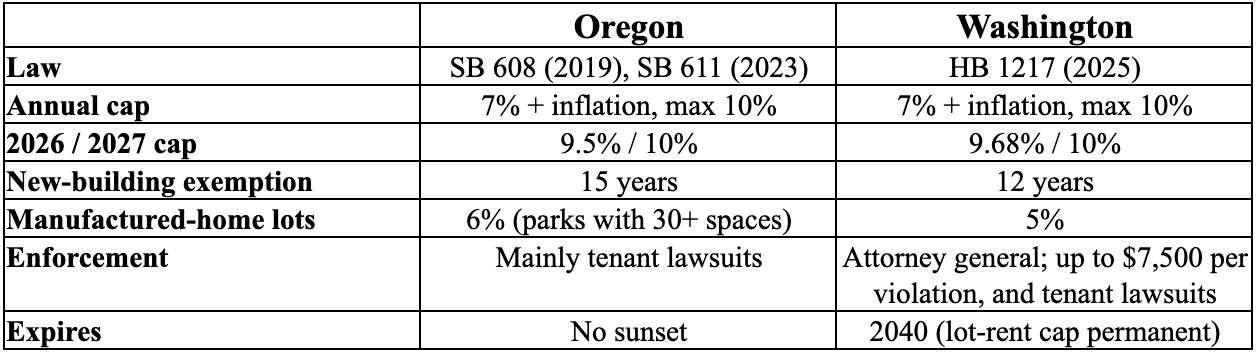
Notably, the laws differ most in who enforces them and how. In Oregon, enforcement falls to tenants: a renter hit with an illegal increase can sue the landlord for three months’ rent plus damages. Washington gives tenants a similar right but also puts the law under the state Consumer Protection Act, so the attorney general can sue and seek penalties of up to $7,500 per violation.
That difference matters because the people a rent cap protects are the least likely to sue. A tenant may not know the cap exists, may not be able to afford a lawyer, and may fear the landlord won’t renew the lease. An attorney general can act on a pattern across a whole building or park, as Washington’s did in winning rent relief for more than 1,000 households in the law’s first year.
Key Policy Takeaway — A Cap That Rarely Binds Still Changes Behavior
On paper, Oregon’s cap should barely matter. A cap only “binds” when it actually stops a landlord from raising rent as much as they otherwise would.
Before 2019, no part of Oregon saw average rents grow anywhere near the roughly 10% a year the formula allowed. The fastest-growing areas averaged about 7%. A cap set above the market is usually a cap in name only.
However, a recent study published in July in the Journal of Housing Economics found otherwise. Using survey data on more than 580,000 Oregon households, the study compared tenants in buildings old enough to be covered with those in newer, exempt buildings, before and after the law.
The results:
Rents grew more slowly. Rents in covered buildings rose about 4.6% less than in exempt ones. In two- and three-bedroom units, which house 71% of Oregon renters, the gap was 9% to 10%.
Tenants moved less. Renters in covered buildings became far less likely to move. Even the study’s most conservative estimate puts the drop at roughly 19% to 27%, and the effect grew over time.
Ownership shifted. Households in covered urban buildings became about 8% more likely to own.
The study’s reading is that landlords and tenants respond to the existence of a cap, not only to its limit. Landlords may hold increases below the ceiling to avoid scrutiny or future tightening. Tenants may stay because they expect protection.
That cuts against both sides of the political debate. For tenant advocates, a “weak” cap turns out to have teeth. For critics, the effects they worried about (tenants locked into below-market units and rentals converted to condos) may show up even when the cap looks harmless.
So, Is It Working?
It depends on what the cap is supposed to do.
Stopping rent shocks: yes. Since SB 611, no Oregon tenant in a covered unit has faced a legal increase above 10%. In 2023, before the ceiling, the formula allowed 14.6%.
Keeping tenants housed: probably, but the evidence can’t say how. The drop in moving is the study’s strongest and most consistent finding. But the data cannot tell a family spared a forced move from a tenant staying put to keep a below-market rent. The first is the law’s goal. The second is what economists call “lock-in,” and it can make it harder for new renters to find a place.
Enforcement: visible in Washington, largely invisible in Oregon. As noted above, in its first year, Washington’s attorney general settled about four dozen alleged violations. Fines topped $800,000, and more than 1,000 households received rent relief, though none of the fines had been collected as of May. Oregon has no comparable public tally.
Housing supply: unknown. Apartment permits have collapsed in both metros. In the Seattle area they fell to about 21 units per 10,000 residents in the year ending March 2025, half the 2020–23 pace, before Washington’s cap took effect. Portland’s construction has fallen even more steeply. Interest rates, building costs, a tech slowdown and Portland’s inclusionary-zoning rules all play a part. No study has isolated the role of either state’s cap.
The study mentioned above also notes one caution about supply. The rise in homeownership in older buildings could mean renters buying their homes. It could also mean landlords selling or converting rentals. The data cannot tell which.
The Strongest Critique Comes From Both Sides
Rent caps draw fire from the right and the left, and Oregon’s record gives each side some ammunition.
From landlords and economists, the worry is supply. The Rental Housing Association of Washington has warned that owners are leaving the market and “the outflow will continue to accelerate.” The broader research supports some caution. In San Francisco, a stricter rent control expansion kept tenants in place but led landlords to convert buildings and cut rental supply by 15%. The aforementioned study’s lock-in finding fits that pattern: fewer moves mean fewer openings for newcomers, and rising ownership in older buildings may signal conversions.
From tenant advocates, the worry is that the cap is too weak. Rents reset between tenants, so a landlord who wants a market rent can wait for turnover. Buildings stay exempt for 12 to 15 years, often the newest units with the steepest rents. And 10% a year is still steep for a household whose pay rises 3%.
Both critiques can be true at once: a cap can be too loose to protect many renters and still tight enough to change who moves and who sells.
Same Formula, Different Bets
The two states share a formula, but Washington made four bets Oregon did not. Each one is a test other states can learn from.
A shorter exemption. Washington’s 12-year window brings buildings into coverage three years sooner. If construction holds up in Washington relative to Oregon, that weakens the argument that a long exemption is needed to protect building.
An enforcer with teeth. Washington’s attorney general has already used the law against noncompliant landlords. Oregon leaves enforcement largely to tenants, a slower and less visible route. If Washington’s cap shows larger effects, enforcement may be the reason.
An expiration date. Washington’s cap expires in 2040 unless lawmakers renew it. That forces a reckoning Oregon never has to face, but it also gives landlords a reason to wait the law out.
A tighter cap on manufactured-home lots. Washington chose 5% with no sunset. Oregon chose 6%, only for larger parks. The Spokane lawsuit may decide whether Washington’s version survives.
One thing travels without a bet. The rolling exemption that made Oregon’s law measurable works the same way in Washington. Every year, a new year’s worth of buildings ages into coverage, giving researchers a natural experiment.
The Blueprint for Other States
Oregon and Washington point to five policy design lessons.
Build the data into the law. Neither state tracks rents on covered units. A simple rent registry or required reporting would let lawmakers measure the cap instead of arguing about it.
Set a hard ceiling, not just a formula. Oregon’s inflation-linked formula allowed 14.6% when tenants could least afford it. A fixed ceiling, as both states now have, is what protects renters in an inflation spike.
Protect new construction with a rolling exemption. A fixed window for new buildings reassures developers, and it gives researchers a clean comparison group.
Give the law an enforcer. A cap tenants must enforce themselves will be unevenly enforced. Washington’s attorney general model, with penalties, makes compliance more likely.
Treat manufactured-home parks as a separate problem. Lot-rent caps protect some of the most vulnerable renters, but a cap with no hardship valve invites lawsuits and park sales. Pair it with a review process for documented cost spikes and support for resident purchases of parks.
Bottom Line
Oregon showed that a statewide rent cap is politically durable. It has survived six years, an inflation shock and a rewrite. It has also shown that a cap doesn’t have to bind to matter: set above what most landlords were charging, Oregon’s cap still slowed rent growth and kept tenants in place.
Washington is now running the same experiment with sharper tools: a shorter exemption, an attorney general to enforce it and a deadline to judge whether it worked. Its first real test comes in 2027, the first full year its cap sits at the 10% ceiling.
Oregon wrote the rent cap. Whether Washington proves it works will depend less on the 10% limit than on the parts around it: who enforces it, and whether anyone measures what it does to renters, landlords and new housing.